For three days in Cincinnati, people from different sectors, cities, generations, and life experiences gathered together not to network, compete, or consume content — but to practice connection.
At Connecting for the Common Good, we asked the question: What becomes possible when we treat connection not as a prelude to the work, but as the work itself?
Hosted alongside a growing circle of partners and community builders, the gathering brought together people working in civic engagement, journalism, education, faith, philanthropy, economic development, organizational leadership, and neighborhood transformation. Yet titles and expertise quickly became secondary.
There were no keynote speakers. No panels of experts answering for everyone else.
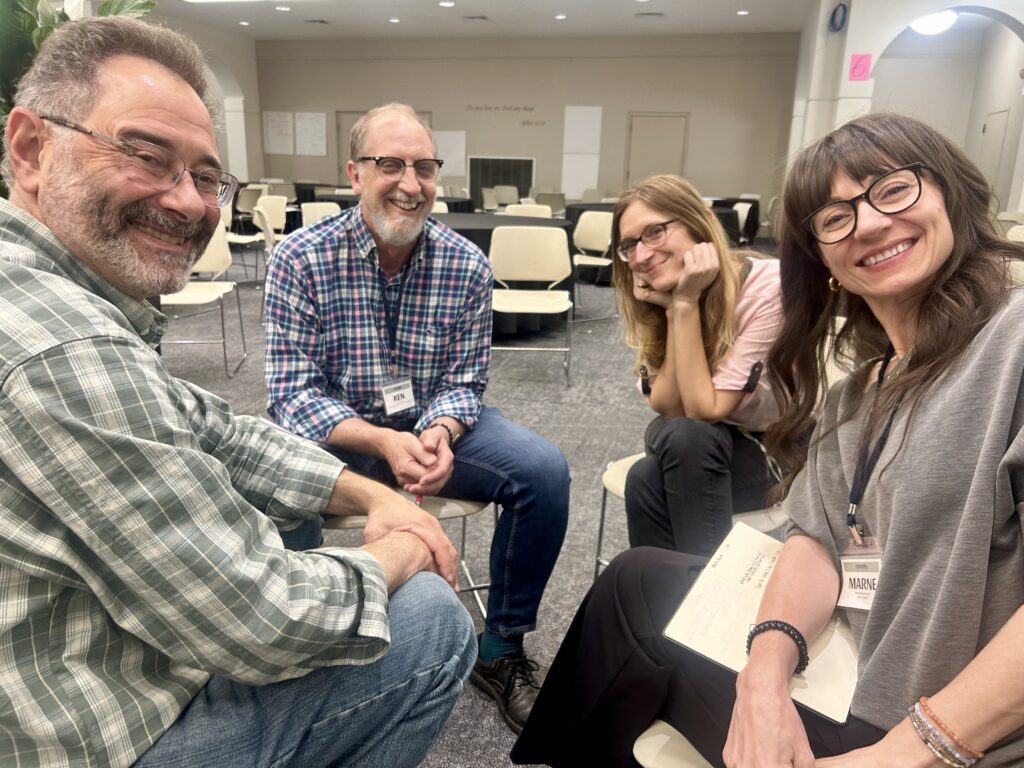
Instead, participants engaged in conversations designed to foster ownership, possibility, dissent, commitment, and gifts: practices deeply rooted in the work of Peter Block and the relational frameworks that have shaped Designed Learning for decades. Small group conversation became the delivery system for learning.
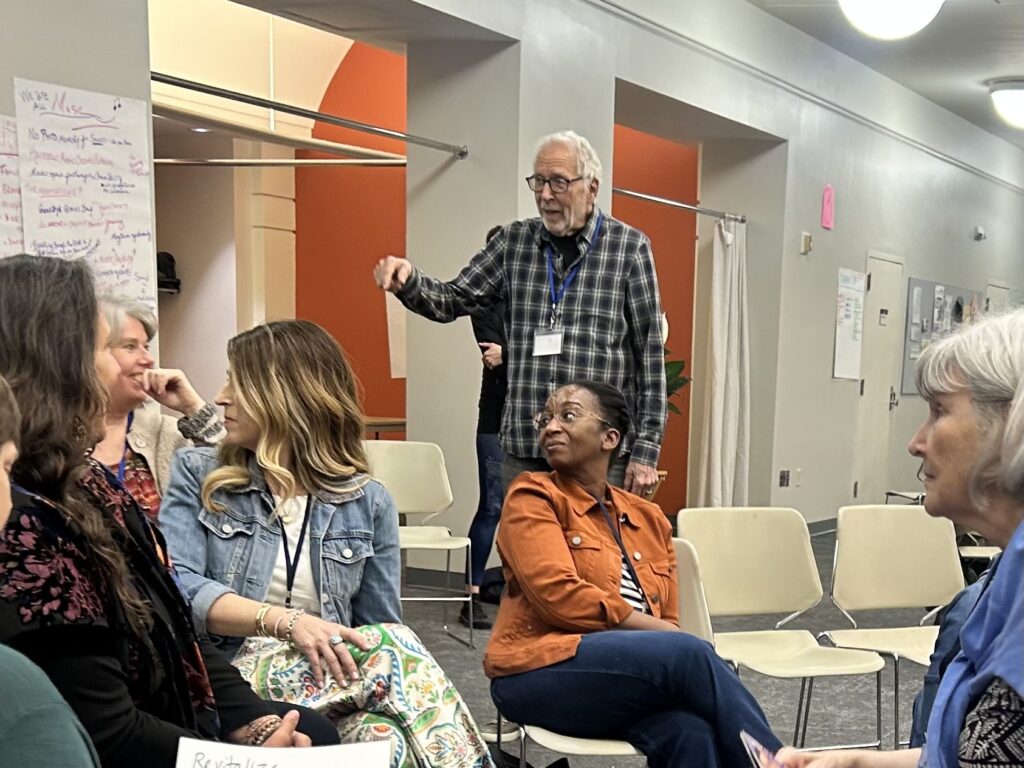
Participants reflected on questions of place, longing, creativity, accountability, and the future of community. Open Space sessions allowed people to convene around what mattered most to them in real time. Community correspondents captured stories emerging from the room, while music, poetry, and art helped anchor the gathering in something more human than information exchange.
The result was not simply engagement.
It was participation.
Many people arrive at conversations about community looking for strategies, frameworks, or scalable solutions. Those things matter. But what often goes unnamed is that fragmentation itself is relational.
Isolation, distrust, polarization, disengagement- these are not only political or organizational problems. They are symptoms of disconnection.
Connecting for the Common Good explored a different possibility: that rebuilding community begins with rebuilding our capacity to be with one another differently.
Not performatively or transactionally but relationally.
Again and again throughout the gathering, participants spoke about the relief of entering a space where they did not need to posture, brand themselves, or prove their expertise to belong.
In a culture increasingly organized around speed, certainty, and performance, the gathering became an experiment in slowing down enough to notice each other again.
What emerged over the course of the gathering was difficult to reduce to a single outcome because the value was not only in the sessions themselves but also in the relationships they formed.
People left with new collaborations, renewed clarity, deeper courage, and a stronger sense that they are not alone in the work they care about most.
Some participants explored new approaches to local journalism.
Others convened around youth engagement, economic participation, neighborhood resilience, or organizational culture, even the best and worst ways to eat a potato!
Many simply rediscovered what it feels like to be in conversations where curiosity matters more than certainty. Perhaps most importantly, people experienced what happens when hospitality, invitation, and ownership are treated as design principles rather than afterthoughts.
Connecting for the Common Good reminded us that transformation rarely begins with large-scale systems change. More often, it begins with small groups of people willing to gather differently, listen differently, and imagine differently together.
The gathering may have ended, but the work continues in neighborhoods, inside organizations, across communities, at dinner tables, within local economies, online at events like Journeys of Growth and Belonging. Through acts of invitation and generosity that rarely make headlines but quietly reshape the social fabric around us.
The future of the common good will not be built by individuals acting alone; it will be built through connection.
And connection, as we were reminded all week long, is not separate from the work.
It is the work.